Sunday, May 9, 2010

Home Sweet Home!

A big hello to all 16 of our followers and anyone else who is reading this! TTUKa-1 (the better-looking radar in the picture above) is back on the road after an unexpected, but welcome trip back to Lubbock. With operations down for Friday and Saturday and the rest of the V2 armada staying in Amarillo, the TTU teams opted out of the hotel to get a couple of nights in our own beds. The break also coincided with a celebration of the 40th anniversary of the Texas Tech Wind Science and Engineering Department, so we were thrilled to be able to make it back for the party and show off all of our instrumentation for the alumni in town for the event.

Prior to the brief trip home, we did get to deploy for the first time in 2010 on an elevated supercell in northwestern Kansas last Thursday. The supercell did not offer much for satisfying research objectives as there was virtually zero chance of it becoming tornadic, but it did offer a great, low-stress deployment to shake off the rust from last season. It was especially nice to get a chance to attempt a coordinated deployment with TTUKa1 and TTUKa2 before we're out on the real deal (which starts tomorrow) to iron out any communications problems.

So, between the "practice" deployment last Thursday and the weekend at home, the TTU teams are well rested, ready, and eager for some tornadic supercells in unpopulated areas to collect data on. And it looks like Mother Nature will oblige us. A deep trough in the southwestern U.S. looks likely to create a severe weather outbreak tomorrow somewhere in central North America, and opportunities for V2 deployments will likely persist through at least Wednesday. So the next time I blog, hopefully I'll have multiple successful deployments to discuss!

Finally, I'm reasonably sure this is of interest to around 0% of you, but it's my blog so I'm including it anyways. One of the challenges of severe thunderstorm field work is finding hobbies to occupy long hours of down time on the road. Over the years, this has led to me becoming a fairly avid birdwatcher. So I'll be using the final paragraph of my postings to update you, the readers, on my progress towards seeing 75 species of bird over the course of V2. Currently, I've picked off most of the likely roadside bird suspects while driving, and have 32 species seen. I'll have to find some opportunities to bird in some better habitat (and not while moving 70 mph) in the upcoming weeks if I'm going to reach the goal.

Wednesday, May 5, 2010

StickNets


Since it doesn't seem likely that we will be doing any operating today, I thought I would take some time to explain some of our instrumentation. Chris has already mentioned that the Texas Tech suite of instruments includes 24 StickNet probes and 2 Ka-band mobile radars. I'll describe the StickNets in a little more detail, and describe our typical operations plan for deploying them. I'll leave the Ka radar descriptions for Pat....

As Chris mentioned, the StickNets are a rapidly deployable surface observing platform. They all feature two primary parts--an extendable tripod (like the kind surveyors use) and a data aquisition (DAQ) box. All StickNets measure wind speed and direction, temperature, relative humidity, and pressure. They all feature a flux-gate compass so that we don't have to worry about orienting them towards a particular direction when we make the deployments. Beyond that, there are some differences. We have two instrument configurations. The first, called an "A" probe features a standard propeller anemometer to capture the wind data, which is mounted on the top of the tripod, a temp/RH sensor (instrument that measures, you guessed it, temperature and relative humidity) that is mounted on the DAQ box, and a barometric pressure sensor located inside the DAQ box. The second configuration, called the "B" probes features an "all-in-one" sensor, meaning that wind speed and direction, temperature, and relative humidity are all collected by one sensor. In additon this sensor can measure precipitation type (hail vs. rain) and can estimate the quantity. This sensor is mounted on the top of the tripod.

It takes 2 people 2 minutes or less to deploy a StickNet. I'll give you a play-by-play of a deployment in my vehicle.....when we pull up to a deployment site, my partner (fellow blogger Rich) and I jump out of the truck and race back to the trailer. After opening the trailer and securing the doors, I will hop in and unhook a tripod. I will jump out of the trailer and head for the deployment site, calling out the probe number to Rich. He will grab the DAQ box, and run out to meet me. By the time he gets there, I have usually extended one of the three tripod legs, and he will set the DAQ box down and together we will work on the last two legs. Then we will take a moment to ensure the probe is level. Then he will lift the DAQ box into place, while I secure it with a pin. I will then power the probe on, hook up the two connectors to power the GPS and instrumentation and turn the data switch on. The software will run a series of tests and once the data light stops blinking, I know the instruments are ready to sample. While I am working on the hookup, Rich is responsible for driving a stake through each of the three tripod legs to secure the probe into position. We generally finish our tasks at roughly the same time, but whoever finishes first runs back to the trailer to close up the doors. We hop into the truck and drive off to the next deployment location. We also have a third member of our team who remains in the truck. He is responsible for keeping a log of all of the deployments, marking the time, GPS coordinates, any obstructions, and any notes that may come in handy. He can also monitor the radio traffic and internet chat to ensure we don't miss any important messages, and also acts as a spotter, keeping an eye on us as we deploy outside of the truck.

Seems like a lot, but yes, we can do it in under 2 minutes and by the end of the season when we've had a lot of practice, we can get much closer to the 1 minute mark!

Before we begin the deployments, Chris instructs us which road we will be using, and what spacing we should allow between the probes. We do our best to keep to the spacing he instructs, but sometimes towns, trees, buildings, etc., get in the way, so we do the best we can. My truck, pulling a trailer, handles one of the two coarse array deployments. Our probes are generally spaced 1-2 miles apart. As the storm gets closer to the deployment road, the non-trailered trucks (which are much more maneuverable) lay down a fine-scale array, centered near where they think a potential tornado or mesocyclone could cross the road.
I included a picture that Kristina Butler took of Brian Hirth and I doing a mock deployment during local media day. He is getting ready to move the DAQ box into place and I am standing by to secure it with the pin. Even after a year of off-time, we finished the deployment pretty quickly! The StickNets are really remarkable. They were designed and built and are maintained entirely by TTU students. Not only are they rapidly-deployable, but because they are unmanned, they can be placed into parts of the storm that you would not want to send people or vehicles! We can deploy them in plenty of time to retreat to safety.

Tuesday, May 4, 2010

Catching up....

Well, the new GPS instruments arrived in Lubbock today, so now the 3 of us who stayed back are finally getting to meet up with the rest of the crew! I'll admit I've been getting pretty stir crazy lately and just really needed to get out of town! Whew! Although, from all I've heard so far, the teams are pretty much just hanging out in Oklahoma, waiting and waiting. At least it will be nice to get back with everyone and stay up-to-date on what's going on. Hopefully we'll have something more interesting to write about next time :)

Later!!

Sarah

Monday, May 3, 2010

Greetings all! My name is Christopher Weiss, an Assistant Professor of Atmospheric Science at Texas Tech University, and one of the Principal Investigators for the VORTEX2 Project. I have a great crew of ~20 faculty, staff and students behind me out here in the field, many of which you have already heard from in previous posts.

We have science objectives that look to be satisfied with the wealth of instrumentation available in VORTEX2. Texas Tech, specifically, has two primary platforms. The first of these is dubbed "StickNet", and array of 24 in situ observation probes, which are deployed in the path of supercell thunderstorms, hopefully capturing key thermodynamic and kinematic gradients in the immediate vicinity of developing tornadoes. Texas Tech also boasts two high-frequency mobile Doppler radars - the TTUKa radars - which are charged with the remote sensing of tornado structure from a distance of about 1.5-2 km ideally. These radars feature a particularly narrow beam, about half degree wide, which allows for resolute data collection very close to the ground, where scientists believe some of the keys to tornado genesis, maintenance and destructive potential are located.

One of my main responsibilities for the field phase of the project is related to the coordination of the instruments. Specifically, I am tasked with aligning the four StickNet vehicles in such a manner to deploy our complement of probes in a safe and efficient manner. The operations plan calls for a lead time of ~60 minutes to run the entire deployment properly. Often, owing to uncertainty in the evolution of the storm or poor road networks, we have a little less time than desired, but still manage to gather scientifically meaningful data safely. The task can be stressful at times, but I find it helpful to draw on past experience in the field (this season is my 12th consecutive).

Another of my responsibilities is to look after the general well being of the crew. In a seven-week project like this, there are bound to be a few illnesses and minor injuries. Beyond physical ailments, though, this type of time commitment comes with a wealth of peaks and valleys in team morale. Though I am far from a cheerleader, I feel it is important to keep the team focused through those rough periods.

We just hit the road today and are currently sitting in northwest Oklahoma for the evening. We do not anticipate a particularly active start to this second year of VORTEX2. Perhaps conditions will slowly improve through the next few days. Many of us actually prefer this type of start - there is a fair amount of spin up necessary to be effective once the real storm intercept opportunities appear later.

Certainly will be more later - I will try to share some of the successes and struggles we encounter through the season.

Sunday, May 2, 2010

Hi everyone! I haven't had the chance to write a blog yet, but here I am finally! I am Sarah Dillingham, a second year Masters student at Texas Tech University. I will be graduating in Fall 2010 with my Masters in Atmospheric Science, and will continue my new job as a broadcast meteorologist for a local station here in Lubbock. I've had a passion for weather my entire life, and I am so excited to be living my dream and doing severe storms research. My meteorological career started at the University of Georgia, where I earned a B.S. in Geography and Atmospheric Science and I have learned a great deal over the past 8 years I've been in college! VORTEX2 is one of the greatest things I may ever have the chance to be apart of, and I hope that our work with the TTU Teams will continue to help further the science.

As I'm sure you've already read from Tanya's blog, Mother Nature is still not ready to give up her secrets for at least a couple more days. With the only viable targets for today and tomorrow being marginal, at best, the powers that be of V2 have decided to forgo operations for today. However, we will be departing tomorrow for sure to begin our now 6 1/2 week journey through the Plains. I'm sure many of you are aware of the GPS issues a few of our teams are facing now, but those new instruments should be coming in on Tuesday morning. I am electing to stay behind and get them, if Dr. Weiss approves :) because I am still working on a proposal for one of my classes. Yes, that's right. I still have some classes that are not yet concluded, so I will not truly be able to enjoy myself for another couple of days......but oh well. I'm just really ready to get out of town, and VORTEX2 is a great way to do that....obviously. This has been a long and difficult semester, and I NEED A VACATION! Haha! Even though I will be doing quite a bit of physical labor during the project, it's a different kind of stress and a version of it that I can handle :) I will be a deployer with StickNet Team 2 this year, and our team will be responsible for deploying the fine scale arrays of instruments, up-close and personal with the supercells! I'm a bit nervous in this particular position as I will be working with one of the veterans of the TTU team, Ph.D. candidate Brian Hirth. Hopefully I'll be fast enough...... ;)

Like many other participants in our group, this will be my last field research project. I am really looking forward to this project again because I learned SO much last year and am anxious to see what the weather has in store for us this season. As we are beginning to transition out of El Nino, we may have an interesting project ahead of us. But only time will tell. Either way, let's hope that if and when the weather gods decide to release their fury again, our teams will all be there to capture it and collect some valuable data. My heart goes out to those who have already been affected by the events over the past two weeks, and hopefully our research will teach us more about tornadoes and other related severe weather events. While we will not be able to stop how the atmosphere behaves, we can surely help you and your families keep yourselves as safe as possible, should you ever be affected by any events.

I guess that's all I have for my first post, but now I guess I better get back to that proposal..... ;) Talk to you all again soon!

Sarah

Two extra days at home


We just got the word that we are down again today. However, we have received confirmation that we WILL be leaving tomorrow. It may be to operate, or just to meet up with the V2 armada, whereever that may be. Pat did a great job of explaining exactly why it is we haven't jumped after the mess of storms off to the east. Those locations are out of the domain for a reason. And our goal is to collect meaningful data, and if we can't do that, there is no point in operating there.

After our tiring week, I think we all enjoyed having yesterday off. I wanted to share with you some photos from my backyard. Last year I was heartbroken that my flowers didn't bloom until after we had begun V2. This year I was lucky enough to get to see them! I have 6 blooming irises and several more that should bloom soon. And my rose bush is full of blooms. An extra day at home made the difference for me!

Other than that, I enjoyed eating lunch at a new pizza restaurant with Ian and my fellow blogger and roommate Sarah. Then had a nice nap with my two beagles. Then a nice "family dinner" of fried fish and corn and potatoes with Ian, Pat, Sarah, Scott, Brian, and Allison. Today....I think we're catching a Tech baseball game!

Saturday, May 1, 2010

And We're Off!!

A big hello to all six of our followers and anyone who is reading this! As you can see from the above image featuring fellow Texas Tech V2 participants Sarah Dillingham and soon to be Dr. Ian Giammanco, we have had an uneventful first day of the project. That does not mean it has been an uneventful weather day as severe thunderstorms and tornadoes have unfortunately effected portions of Arkansas, Mississippi, and Tennessee. Our hearts go out to everyone effected by today's weather and it's natural to wonder why VORTEX2 wasn't out to collect data on these storms. The first reason is purely practical, it wasn't logistically possible to get from Lubbock, Texas to eastern Arkansas in a single day to be in the proper position. The second reason requires that we draw a distinction between simply seeing tornadoes and collecting meaningful data on tornadoes, which also lends itself to a discussion on the role of the TTUKa mobile Doppler radars that I will be working with this year. I'll try to outline the distinction below:

One of the primary research thrusts of the "tornado-scale" radars participating in V2, which consist of the two TTU Ka-band radars, the Rapid-Scan Doppler on Wheels, and the UMASS W-Band radar, is to collect multiple-Doppler datasets of tornadoes (and hopefully tornadogenesis) very near the ground. This region, known as the "corner-flow" region is where strong inflow into the vortex is tilted into the vertical to ascend within the tornado. Very few observations have been made of the corner-flow region and to the best of my knowledge, no dual-Doppler datasets of the region exist. As the majority of people inhabit the same near-ground region, a better understanding of the corner-flow region will hopefully lead to a better understanding of how tornadoes produce damage and to safer building designs.

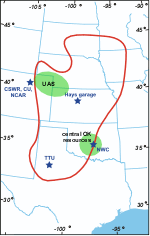
That said, there is a reason very few datasets of the low-level tornado vortex structure exist. In order to obtain the desired measurements, multiple high-resolution Doppler radars need to be properly placed in positions very close to the tornado with nothing obstructing their view such as trees, buildings, or terrain features, and they also need to have little or no precipitation falling between their position and the tornado. The reason for these requirements involves the tradeoffs necessary to make when designing a Doppler radar. The tornado-scale radars have sacrificed the ability to scan over long distances and through heavy precipitation in order to have very high spatial resolution and a greater sensitivity to make accurate velocity measurements. Therefore, to maximize our chances of getting an unobstructed view of the tornado with the Doppler radars (and to keep wind measurements from surface observing equipment such as StickNet from being influenced by vegetation and terrain) V2 will primarily target storms that form in very flat regions with few trees (http://www.eol.ucar.edu/projects/vortex2/images/v2_domain_70dpi.gif).

It's a pretty tall order to get an unprecedented dataset, but we should get several chances over the coming weeks and hopefully we can nail a few events. I'll be here to post the summary once we do!